Image Credit: docmonstereyes from USA/Wikimedia Commons/CC BY 2.0
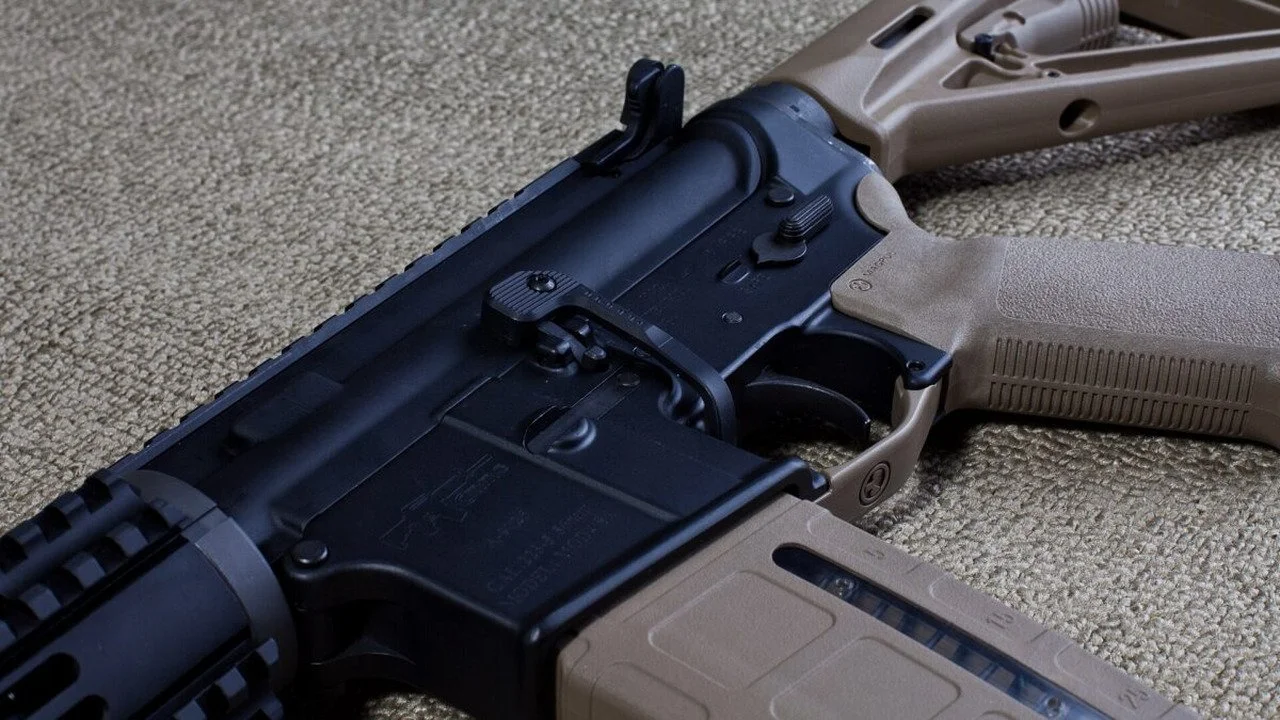
The Supreme Court is scheduled to hear oral arguments next week in two cases asking whether "assault weapons" bans on AR-15s and similar semiautomatic rifles violate the Constitution. In Khaya v. Cook County (formerly Viramontes v. Cook County) and Grant v. Higgins, the justices will consider whether bans enacted by Cook County, Illinois, and Connecticut violate the Second and 14th Amendments. Oral arguments are set for 10 a.m. ET on Dec. 2.
Former Virginia Attorney General Ken Cuccinelli said the effort to ban the rifles "is really not driven by numbers or harm. It's driven by a political agenda that is just anti-gun in general." American Suppressor Association General Counsel Michael Williams said the movement to restrict AR-15s dates to the late 1980s and early 1990s and was designed "to villainize AR-15s and conflate them in the public mind with M-16s or automatic firearms." "Your typical civilian-owned AR-15 is not the same thing," Williams said, describing it as "a semiautomatic firearm that looks similar to an M-16, but importantly, shoots only one round with every pull of the trigger."
Roughly a dozen states and Washington, D.C., have implemented laws banning or restricting AR-15 ownership, according to Newsweek. Williams said available figures show most gun-related homicides in America are committed with handguns, not rifles. FBI data from 2024 found that 53 percent of gun-related homicides involved handguns, while rifles (including "assault weapons") accounted for 3 percent. "They're trying to solve a problem that doesn't really exist," Williams said. The court declined to take up a challenge to Maryland's restrictions last year, despite protests from Justices Clarence Thomas, Samuel Alito, and Neil Gorsuch. Justice Brett Kavanaugh, while agreeing with the denial, wrote that the court "should and presumably will address the AR-15 issue soon, in the next Term or two."
The court's analysis is expected to follow its 2022 decision in New York State Rifle & Pistol Association v. Bruen, which set a two-step test: whether the regulated conduct is covered by the Second Amendment's plain text, and if so, whether the regulation is consistent with the nation's "historical tradition of firearm regulation." Williams said the Cook County and Connecticut bans, which he called "devastating," do not "hold up at all" under that framework. Citing the 2008 decision in District of Columbia v. Heller, he said such rifles are "certainly under common use" and are "neither dangerous nor unusual."
The sole question the justices agreed to consider is whether the Second and 14th Amendments "guarantee the right to possess AR-15 platform and similar semiautomatic rifles." The challengers' brief said Cook County and Connecticut bans on magazines holding more than 10 rounds "are not challenged and are not at issue in these cases." Cuccinelli expressed hope the court could still address magazines, but said, "It wouldn't surprise me in the least bit if they kicked it down" the road. In an amicus brief for the National Association for Gun Rights and Texas Gun Rights, the groups argued that "a holding that protects the rifle but not the parts that make it function would leave the AR-15, as actually manufactured and sold, banned in every enacting jurisdiction."
Cuccinelli and Williams expressed optimism that the court will find the bans unconstitutional. Cuccinelli predicted a 6-3 ruling and did not close the door on Justice Elena Kagan concurring in the judgment if she "is finally willing to accept the [court's] line of case law," while saying "you'll get nothing like that out of [Justices Sonia] Sotomayor or [Ketanji Brown] Jackson." Williams said he will be watching justices who tend to gravitate "towards the middle," specifically Kavanaugh and Chief Justice John Roberts.